Covington sits on the north shore of Lake Pontchartrain, between the Bogue Falaya and Tchefuncte rivers, and its winters run noticeably colder than the south shore’s. Its streets mix houses built before 1940 with subdivisions finished in the last decade, and the city enforces its own flood elevation rules on top of FEMA’s.
A heating and cooling system in Covington carries a different load than the same system in New Orleans, and the difference starts with the heating side.
Most HVAC advice for this region is written around the long cooling season. That season is real here too, but Covington’s winters, its mix of old and new houses and its flood rules all change what a good system looks like.
At Big Easy HVAC, we install and service heating and cooling systems in Covington homes, and these local conditions are where our recommendations start.
If you are weighing a repair or a replacement, contact us and we will walk through the options for your house.
This guide covers what Covington’s weather asks of a system, how the age of its housing changes the job, how homes here heat, and what the city’s flood rules mean for equipment.
Covington Weather Asks More of the Heating Side
The cooling season still dominates the year in Covington, but the heating season matters far more than it does across the lake. NOAA’s 1991 to 2020 climate normals for its Covington 4 NNW station show the gap clearly.
More Heating Degree Days Than the South Shore
Heating degree days measure how much heating a climate demands over a year. NOAA’s normals give Covington about 1,670 of them, against about 1,019 at its New Orleans Audubon station.
That works out to roughly 64 percent more heating demand on the north shore. A furnace or heat pump in Covington simply does more work each winter than one in the city.
About 29 Freezing Nights a Year
The same normals average about 29 days a year when the low reaches 32 degrees or colder. January’s normal low is about 40 degrees, and its normal high is about 62.
Nights like that are when the heating side of a system gets tested. A heat pump chosen mainly for its cooling capacity is the most likely to lean on backup heat when they arrive.
A Cooling Season That Still Runs Long
None of this makes Covington a heating town. NOAA’s normals still show about 2,406 cooling degree days, and about 83 days a year reach 90 degrees or hotter, with July and August highs near 90.
The system has to handle both seasons well. That is the core difference from the south shore, where the cooling side carries nearly all of the load.
Two Housing Eras on the Same Streets
Covington is an old town with a lot of new houses in it. That mix means two homes a block apart can need very different answers from the same contractor.
A Town Laid Out in 1813
The City of Covington’s history traces the town plan to a map deposited with the parish judge on July 4, 1813. The city describes streets laid out before the automobile and live oaks more than 200 years old.
Houses around the historic center were built long before central air was standard. Our Covington service area page explains how that changes the first question on an older home, which is often where ducts can physically go.
Most Homes Built Since 1980
The Census Bureau’s 2020 to 2024 American Community Survey estimates Covington has 4,640 housing units. About 71 percent of them were built in 1980 or later, and about 37.6 percent were built in 2000 or later.
Homes from the 1980s and 1990s make up about a third of the total, 33.3 percent. Those houses are now older than the average equipment lifetimes FEMP assumes for a furnace or a heat pump, so many are on their second system or due for one.
At the other end, about 7.6 percent were built in 1939 or earlier. These are survey estimates with margins of error, but they confirm what a drive through town suggests: most systems here sit in houses from the last four decades, with a historic core that needs a different approach.
What Each Era Usually Needs From a System
In a newer house, the ducts and the equipment usually came with the build. The question is whether the system was sized and installed for the house, or simply for its square footage.
In an older house, the ductwork was added later or never added at all. There, the route for the ducts and the location of the equipment often decide what kind of system makes sense.
How Covington Homes Heat
Heating fuel is where Covington homes split most clearly. The choice shapes what a system needs and what can go wrong with it.
A City Split Almost Evenly on Heating Fuel
The Census estimates show 49.0 percent of Covington’s occupied homes heat with utility gas and 48.3 percent with electricity. Bottled or tank gas accounts for about 2.2 percent.
In practice, that means a Covington household is about as likely to rely on a gas furnace as on an electric system such as a heat pump.
Heat Pumps on a Colder North Shore Night
A heat pump heats with electricity and the same refrigerant circuit it uses for cooling. The Department of Energy’s Federal Energy Management Program notes that residential heat pumps are often chosen for their cooling capacity, with electric resistance elements added to make up the heating shortfall.
Those elements are inefficient, and the same guidance says their use should be kept to a minimum. It recommends thermostats built for heat pumps, which raise the temperature slowly to avoid switching them on.
A gas furnace’s efficiency is rated by AFUE, the share of the fuel’s energy that becomes useful heat over a season. FEMP’s buying guidance assumes an average residential furnace lifetime of 21 years, compared with 15 years for a heat pump.
With more heating degree days than the south shore, a Covington furnace logs real hours every winter. Our gas furnace services cover installation, servicing and repair, and our post on how furnace heating systems work explains the parts involved.
Flood Rules That Shape Where Equipment Goes
Covington sits between two rivers, and NOAA’s normals for its station put annual rainfall at about 62.5 inches. Its flood rules affect where a new house, and the equipment serving it, can sit.
Two Rivers and More Than 1,500 Flood Policies
The City of Covington says it can be vulnerable to severe damage from high winds and associated flooding, and it posts river gauges for the Bogue Falaya and Tchefuncte. The city reports more than 1,500 flood insurance policies in effect.
It also notes that about 25 percent of flooding happens outside areas formally designated as flood prone. A property outside the mapped flood zone is not automatically out of reach of water.
The city also makes a point that is easy to miss. Base flood elevation is a height above sea level, not a depth of water, so the depth a property could see depends on how high its own ground sits.
What the City Requires
Situation
What the City Says
Best Time to Plan HVAC
New home in the floodplain
Elevated at least 1 foot above base flood elevation
At design, alongside the house elevation
Substantial improvement (50 percent of market value)
Existing building elevated to base flood elevation
Before the renovation scope is set
Any elevated building
Elevation Certificate from an engineer or surveyor before occupancy
Once the elevation is known
Replacing equipment only
The Permits Department can confirm where the property sits
Before choosing where the new unit goes
One Foot Above Base Flood Elevation for New Homes
Federal floodplain rules require new homes and substantial improvements in the floodplain to be elevated to the base flood elevation. Covington goes further for new construction, requiring at least 1 foot above it, a margin the city calls freeboard.
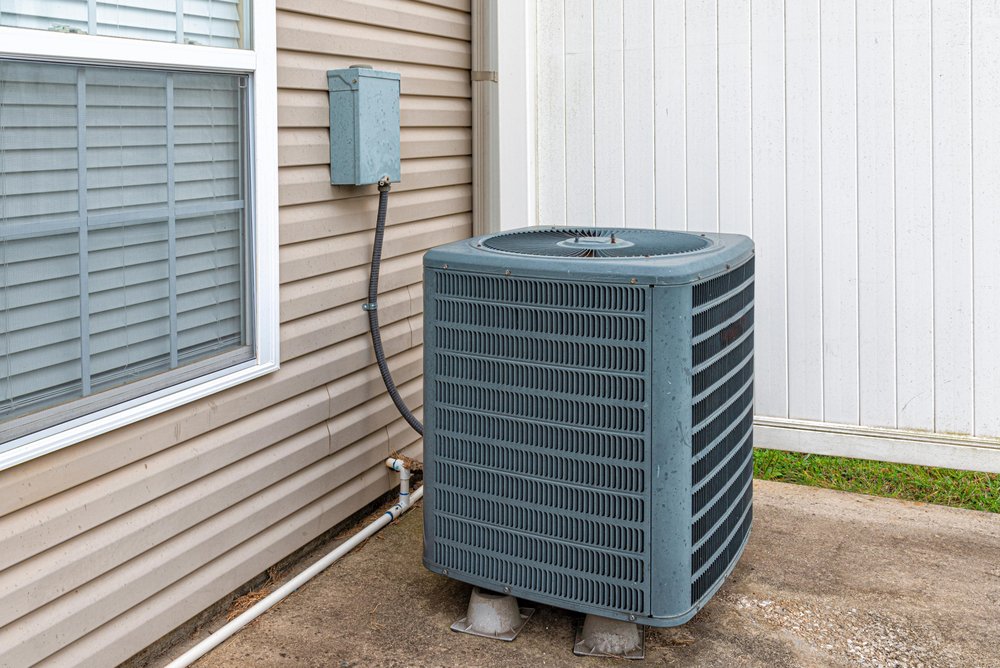
FEMA’s guide to protecting building utilities notes that for new construction, flood rules and building codes require HVAC components at or above the required flood protection level. In a new Covington house, the equipment location belongs in the same conversation as the elevation.
The 50 Percent Rule for Renovations
The city treats a structure as substantially improved when the cost of the work equals or exceeds 50 percent of the building’s market value. Those projects must meet the elevation standard too.
If a new system is part of a larger renovation, check that threshold with the city first. The Permits Department will review floodplain information on file to say where a property sits.
To prove a building was raised correctly, the city requires an Elevation Certificate from a professional engineer or surveyor before it can be occupied. If you are buying or renovating a home that has one, it is a useful reference when deciding how high new outdoor equipment should go.
Planning Your Next HVAC Decision in Covington
A Covington system needs a strong heating side as well as a strong cooling side, and it often sits in a house that was either built recently or long before central air. Those two facts shape most of the right answers here.
Start with what you already know: how your home heats, roughly when it was built and whether it sits in or near a mapped floodplain. Those three details narrow the choices more than any brochure.
If your current system leans on backup heat on cold nights, or your home feels damp in summer, both are worth a look before the next season. Our guide to spotting indoor air quality problems in a humid home covers the summer side.
To have your Covington system looked at before the next cold snap, call us today at 504-285-5606!
Frequently Asked Questions
Is Covington colder than New Orleans?
Yes, in winter it is. NOAA’s 1991 to 2020 normals give its Covington station about 1,670 heating degree days a year, compared with about 1,019 at New Orleans Audubon. The Covington station also averages about 29 nights a year at or below freezing.
Should a Covington home use a heat pump or a gas furnace?
Both are common, and Census estimates show Covington homes split almost evenly between gas and electric heat. A heat pump runs on electricity and may call on backup resistance heat, while a gas furnace burns fuel to make its heat. The right choice depends on the house, its ductwork and whether gas service is already in place.
Why does my heat pump run backup heat on cold mornings?
Heat pumps are often sized for cooling, so electric resistance elements are added to cover the heating shortfall. The Department of Energy’s FEMP guidance says those elements are inefficient and their use should be kept to a minimum. A thermostat designed for heat pumps raises the temperature slowly to avoid triggering them.
How long does an HVAC system last in Covington?
There is no single figure, but federal buying guidance assumes an average residential furnace lifetime of 21 years and a heat pump life of 15 years. Covington’s heavier heating load means a system here logs more winter hours than one across the lake. Regular service and a correct installation matter more than the calendar.
Are older Covington homes harder to fit with central air?
They often take more planning. Houses from the town’s early years were built long before central air, so the ductwork was added later or never added. The duct route and equipment location usually come first, and in some homes a ductless system is the more practical answer.
Do I need a permit to replace an HVAC system in Covington?
Check with the city before work starts. The City of Covington’s Permits Department reviews floodplain information for a property and handles flood-related permits. Larger renovations that reach 50 percent of market value also trigger elevation requirements.
Is my Covington home in a flood zone?
The city’s Permits Department can tell you where a property sits relative to the floodplain, using FEMA’s Flood Insurance Rate Maps and the studies on file. The city also notes that about 25 percent of flooding happens outside designated flood-prone areas. Check before choosing where new outdoor equipment goes.
Do you serve homes outside Covington city limits?
Yes. Every residential service we offer covers Covington and the rest of St Tammany Parish, and we also serve Mandeville, Madisonville and Slidell. Estimates are free on every service.
As winter approaches, it is important to make sure your HVAC unit is ready for the colder weather. Regular HVAC maintenance and inspection of your system can help ensure that you are not caught off...
A maintenance plan is only as good as the checklist behind it, and there is a free national minimum most homeowners have never heard of.
If you have shopped for an HVAC maintenance plan, you have p...
Hammond sits 45 miles northwest of New Orleans, north of Lake Pontchartrain, at an elevation of 39 feet. The air here holds 76% relative humidity as a yearly average and 79% through July. Your air ...
Do furnace heating systems typically work? It’s a common question that many homes and business owners have when considering installing or replacing an existing system. But to understand how they op...
Air duct cleaning removes the dust, debris, and buildup that collect inside a home's ductwork over time. The EPA has never called it routine maintenance, and recommends it only under specific condi...
Gretna sits on low ground on the west bank, in a climate that keeps air conditioners running for most of the year. Much of its housing went up long before central air, and the city itself says ever...

 Oct 19, 2026
 The City of Covington says it can be vulnerable to severe damage from high winds and associated flooding, and it posts river gauges for the Bogue Falaya and Tchefuncte. The city reports more than 1,500 flood insurance policies in effect.

 By Admin